
The Direct Link Between Kitchen Discipline and Operating Margins
Every commercial kitchen experiences friction between purchased inventory and actual customer plates. For veteran business owners accustomed to operational rigor, precision logistics, and disciplined execution, food waste is not merely an unfortunate cost of doing business. It is a critical operational leak. When inventory spoils in walk-in coolers, gets over-portioned on the line, or ends up discarded during prep shifts, capital drains straight out of your net profit margins.
Traditional restaurant operations have historically treated food waste as a cost of goods sold (COGS) variance that gets addressed reactively at the end of the month. Clipboard waste logs sit by the prep tables, ignored during rush hours or filled out with inaccurate guesswork at the end of a long shift. When waste tracking relies entirely on manual memory and tired staff, the resulting data is incomplete, late, and largely useless for tactical decision-making.
Restaurant waste reduction automation fundamentally changes this operating dynamic. By shifting the entire operational rhythm from reactive cleanup to automated, preventive oversight, intelligent kitchen hardware and software convert discarded inventory into actionable financial intelligence. When food waste tracking is fully automated, environmental responsibility stops being an abstract public relations exercise and becomes a tangible byproduct of operational excellence and relentless cost reduction.
How Waste Reduction Automation Works in Modern Kitchens
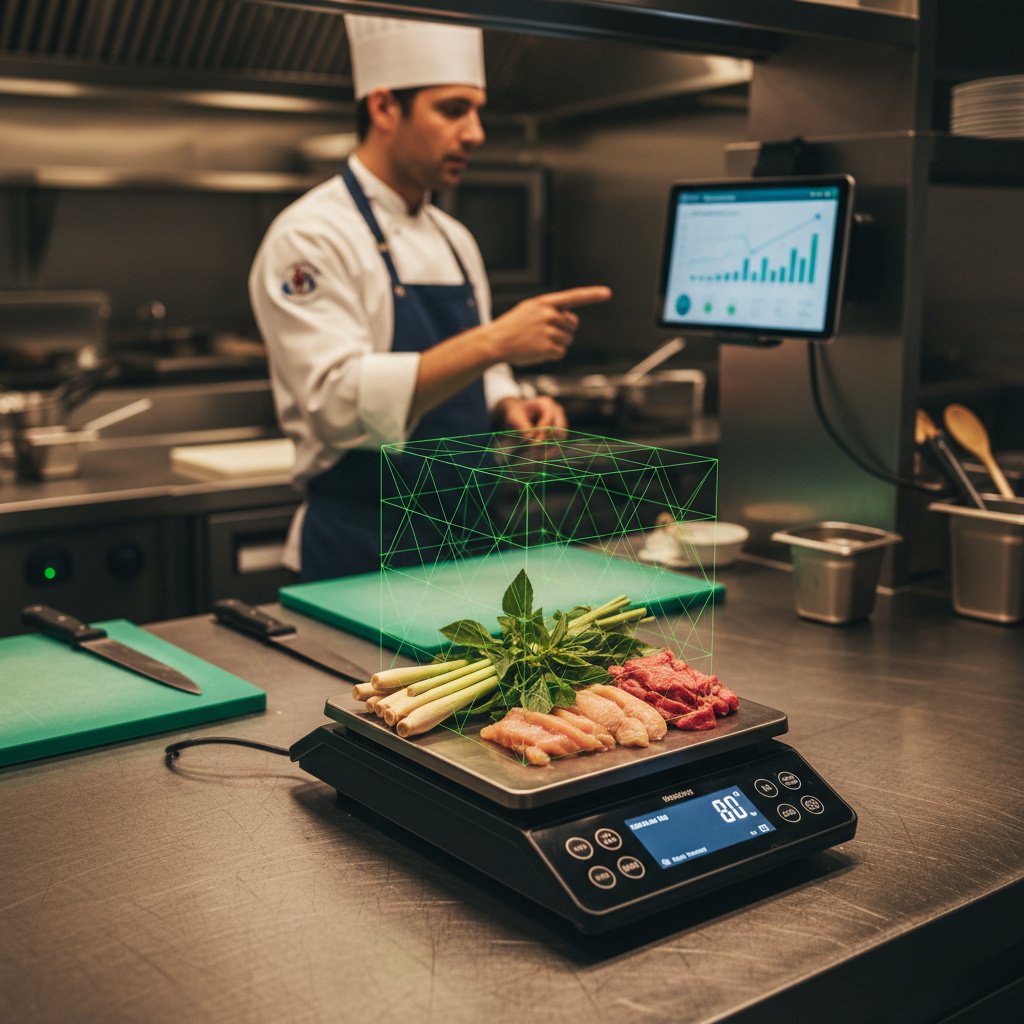
Modern automated kitchen waste management systems replace subjective clipboards with connected hardware and machine intelligence. These setups typically integrate overhead optical sensors, computer vision cameras, precision smart scales, and seamless links to point-of-sale (POS) and inventory management software.
The mechanics are straightforward, fast, and engineered to fit seamlessly into high-tempo kitchen environments:
- Computer Vision and Automated Recognition: As kitchen staff clear prep stations or discard trim, an overhead smart camera uses deep learning models to visually classify the item—distinguishing between prime proteins, raw produce trim, sauces, and finished plate waste.
- Precision Mass Measurement: Connected scales beneath disposal receptacles instantly register the weight, timestamp, and station location without requiring manual data entry from line cooks.
- Financial Translation in Real Time: The system automatically cross-references the item’s weight with recipe costing models and current vendor purchasing prices stored in your inventory management database.
- Shift-Level Root-Cause Tagging: The system identifies whether the discard was caused by prep spoilage, expiration, overproduction, incorrect temperature holding, or customer plate waste.
Consider a high-volume Thai restaurant operating seven days a week. Specialized ingredients like fresh Thai basil, makrut lime leaves, lemongrass stalks, coconut cream, and pre-marinated proteins possess tight shelf lives and high volatility. A manual log rarely captures the subtle, incremental loss when four pounds of aromatic herbs spoil on a slow Tuesday afternoon, or when prep cooks discard excessive usable protein while trimming chicken satay. Automated vision systems detect these variances immediately, turning an invisible operational leak into clear, actionable data within seconds.
The Financial Equation: Lowering COGS by 2 to 4 Percentage Points
In the hospitality industry, where net operating margins frequently hover between 4% and 9%, an improvement of even a single percentage point on your food cost line can double a location’s profitability. Automated waste systems deliver direct financial ROI by exposing over-ordering, poor prep yield, and portion inconsistency before they compound across weeks.
Industry data indicates that deploying automated tracking and using that telemetry to adjust prep schedules and purchasing pars can cut food cost percentage by 2 to 4 full points. In an operation generating $1.5 million in annual revenue, shifting food cost down by 3% reclaims $45,000 in raw margin every single year. Emerging AI kitchen automation vendors point to reductions of up to 60 percent in edible kitchen waste under disciplined management protocols. While vendor projections represent optimized conditions, the fundamental math holds true: when you measure waste accurately, you eliminate unforced financial losses.
Automated dashboards allow restaurant owners and general managers to evaluate operations across granular dimensions:
- Waste by Daypart and Shift: Determine whether overproduction happens during prep or night-shift cleanouts.
- Item-Level Yield Variances: Compare the usable yield of fresh produce across different vendors to negotiate better supplier contracts or change specifications.
- Recipe Cost Alignment: Adjust standard portion controls on dishes with high plate-waste volumes, keeping guest satisfaction high while lowering ingredient spend.
Sustainability as a Natural Byproduct of Operational Efficiency
Environmental responsibility in food service is most sustainable when it reinforces business survival and profitability. When veteran business owners minimize kitchen waste through automation, the ecological benefits are immediate and substantial.
Every pound of food discarded in a commercial dumpster carries an embedded environmental cost: the diesel consumed in transit, the hundreds of gallons of agricultural water required to cultivate crops, the energy consumed by cold storage, and the methane emissions produced in municipal landfills. Tightening prep pars and stabilizing inventory through automation eliminates waste at the source rather than attempting to manage it downstream.
In specialized ethnic culinary concepts such as a Thai restaurant, kitchen waste reduction automation allows operators to honor traditional, ingredient-intensive cooking techniques while upholding modern sustainability benchmarks. Fresh herbs, fragile vegetables, and specialty sauces maintain peak freshness because purchasing is synced tightly to verified demand patterns. Furthermore, clean tracking enables responsible secondary utilization—such as converting vegetable trimmings and bones into deeply flavored broths and bases—closing the operational loop and driving near-zero waste kitchens.
Phased Tactical Implementation: A Playbook for Operators
Deploying kitchen technology fails when it adds friction to line cooks or creates administrative clutter for shift supervisors. Technology must serve the frontline operator. A disciplined, staged rollout ensures that waste tracking automation delivers fast ROI without disrupting kitchen service.
Phase 1: Baseline Establishment and High-Waste Focus
Begin by deploying the system at primary prep stations and protein lines where ingredient costs are highest. Run the system passively for two weeks to capture true baseline waste habits without altering existing kitchen routines. This baseline exposes the exact dollar amounts lost to prep trim, expiration, and batch overproduction.
Phase 2: System Calibration and POS Integration
Map your automated waste system directly into your POS sales data and recipe management database. Ensure accurate cost-per-ounce figures for all raw ingredients. Set daily threshold alerts so kitchen managers receive automated notifications when prep waste crosses predefined financial limits.
Phase 3: Crew Integration and Standard Operating Procedures (SOPs)
Train shift supervisors and line cooks on the mission. Frame the automated tracking system not as an intrusive monitoring tool, but as an operational asset designed to keep inventory fresh, streamline prep workloads, and ensure smooth service. Clear feedback loops—such as weekly shift huddles reviewing food cost wins—build team pride and accountability.
Phase 4: Predictive Purchasing and Par Optimization
Once baseline accuracy is locked in, use automated waste analytics to overhaul order guides and par sheets. Align daily prep sheets directly with dynamic demand forecasts, cutting slow-moving prep batches and ordering high-risk perishables on tight, just-in-time schedules.
The Bottom Line
Precision, accountability, and disciplined resource management are the hallmarks of successful veteran-led enterprises. Kitchen waste reduction automation strips away the uncertainty of manual logs, replacing gut feelings with objective operational telemetry. By viewing waste reduction as an engineering challenge and a cost reduction strategy, restaurant operators protect their profit margins, streamline kitchen workflow, and set a high standard for environmental responsibility.
Book a 15 minute discovery call to find out more today at https://digifidelis.com/calendar/











[…] businesses: Grants, tax breaks, and low-interest loans tailored for veteran businesses. […]
[…] platforms like Instagram and Facebook to create […]
[…] Examples of Workflow […]
[…] Automation tools collect and analyze data, giving you insights to make smarter choices. Google Analytics, for instance, tracks website…
[…] like LinkedIn and Instagram are powerful networking tools. Share valuable content, engage with industry leaders, and showcase […]