
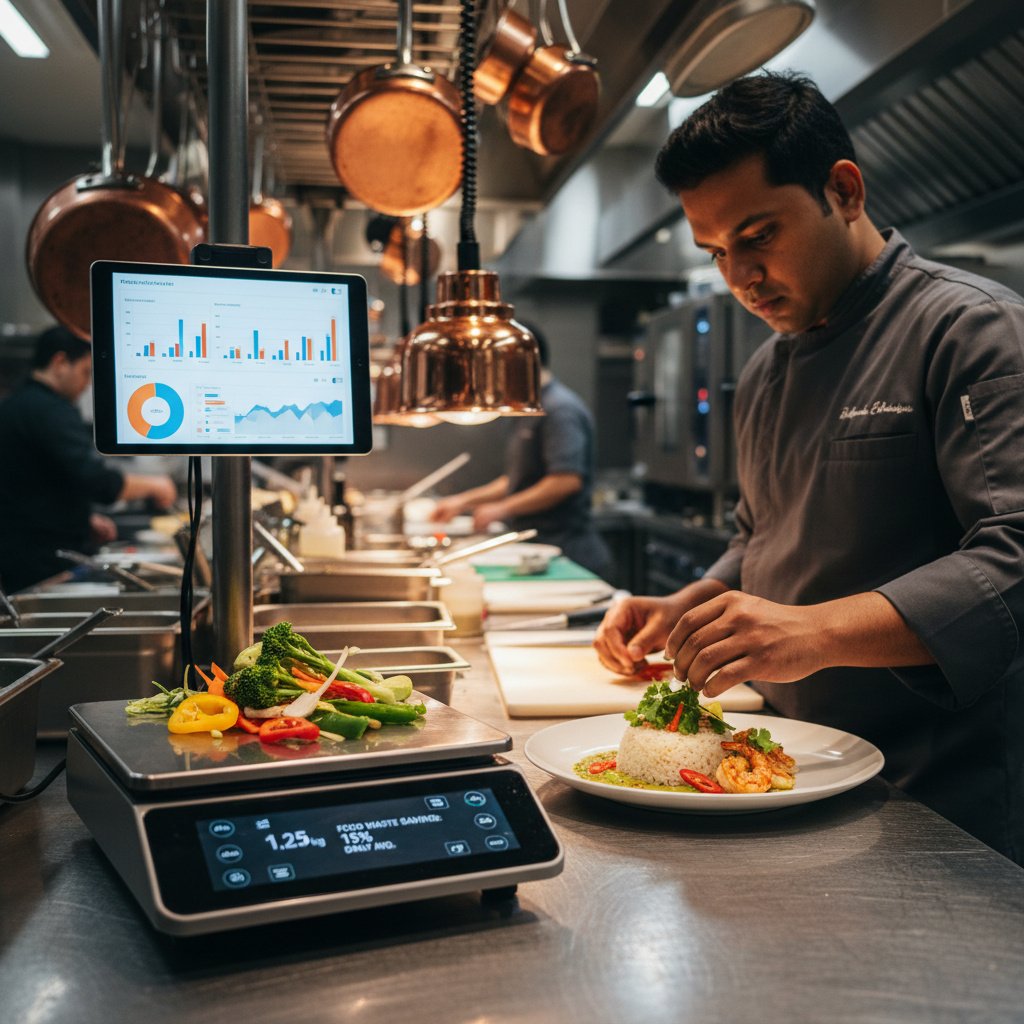
Every commercial kitchen harbors an unseen leak where profit quietly drains away. In the high-velocity environment of restaurant operations, back-of-house food waste has long been treated as an inevitable cost of doing business. Trash cans swallow prep trimmings, overportioned entrees, spoiled specialty ingredients, and expired sauces without leaving an audit trail. For veteran business owners accustomed to operational discipline, this lack of visibility represents a critical breakdown in command and control.
Today, restaurant waste reduction automation has shifted from a well-meaning environmental initiative into a rigorous operating system. By integrating artificial intelligence, connected optical scales, point-of-sale (POS) systems, and real-time inventory management, modern operators can transform ambiguous loss into precise, actionable intelligence. Sustainability and profitability are no longer competing priorities; they are the direct byproduct of tighter operational control.
The True Mechanics of Kitchen Margin Leakage
Food cost percentage is the pulse of any restaurant. When margins hover between 3% and 7%, a 2% swing in food cost can dictate whether an operation thrives or suffocates. Traditional food waste management relies on manual guesswork, end-of-month inventory reconciliations, or anecdotal observations from shift supervisors. By the time a discrepancy appears on a profit and loss statement, the financial damage is already done.
Automated waste tracking solves this by capturing discarding events at the point of loss. A standard automation stack consists of an AI-enabled camera and scale mounted directly above waste bins, synchronized with the kitchen’s POS and inventory software. When a line cook scrapes a pan or discards expired product, the system instantly identifies the item, measures its exact weight, classifies the reason (spoilage, over-prep, burnt item, or plate return), and calculates its direct financial cost.
What gets measured gets managed. Converting discarded items into hard financial data exposes margin leakage in real time. Rather than asking why food cost ran high last month, a general manager can see that the sauté station overproduced thirty portions of coconut curry base between 2:00 PM and 4:00 PM on Tuesday.
A Layered Decision Architecture for Kitchen Operations
Implementing waste reduction technology is not about adding complex gadgets to a crowded line; it is about establishing a continuous feedback loop. Experienced operators structure this process across four systematic stages:
1. Automated Measurement at the Source
Precision begins with friction-free logging. AI-powered image recognition eliminates the need for cooks to type codes into spreadsheets. The camera scans the bin, logs the ingredient, and records the weight automatically. This consistent recording builds an objective baseline across shifts, stations, and prep teams.
2. Cross-System Data Analysis
Raw weight data becomes operational intelligence when merged with sales patterns and inventory depletion rates. When connected to the POS, the system highlights discrepancies between what was purchased, what was sold, and what went into the bin. This analysis uncovers whether losses stem from supplier over-ordering, poor prep scheduling, or portion inflation.
3. Standard Operating Procedure Refinement
Data without action is overhead. Automated insights guide targeted operational adjustments: tightening prep pars, altering batch sizes, adjusting order points with vendors, or retraining line cooks on yield butchery. When data reveals that twenty pounds of fresh herbs consistently spoil on Sunday evenings, automated ordering rules adjust Friday delivery volumes accordingly.
4. Continuous Performance Review
Automated daily and weekly executive summaries provide clear accountability. Store managers review waste variance reports alongside labor and sales, establishing repeatable operational standards that eliminate reliance on memory or shifting kitchen personnel.
Operational Precision in Action: The High-Volume Thai Kitchen
The value of automation becomes immediately apparent in complex culinary models like a busy Thai restaurant. Thai cuisine depends heavily on volatile, highly perishable fresh ingredients—Thai holy basil, lemongrass, kaffir lime leaves, fresh galangal, coconut milk, and scratch-made curry pastes. Furthermore, menu customization around spice tiers, protein substitutions, and noodle bases creates massive prep variability.
In an uncontrolled environment, kitchen prep crews often overproduce high-cost protein batches or batch-cook gallons of curry paste to survive a rush, only to discard unused portions at closing. High-turnover specialty produce like Thai basil wilts rapidly if not rotated with strict FIFO discipline.
With automated waste tracking, a Thai restaurant operator gains granular insight into modifier trends and discard patterns. The data might show that specific protein substitutions generate consistent plate waste, indicating an oversized standard portion. It might reveal that daily pad Thai noodle prep consistently exceeds evening sell-through by 18%. By anchoring production pars to actual consumption, the restaurant preserves authentic flavor and culinary integrity while slashing unnecessary ingredient spending.
Scaling Consistency Across Multi-Unit Operations
For veteran entrepreneurs scaling from a single location to multiple units, operational variance across stores is a primary obstacle. One unit may run a pristine 28% food cost while another location using the same menu runs at 34%. Without automated tracking, pinpointing the cause requires hours of physical audits and subjective manager interviews.
Automated waste tracking provides a unified dashboard that standardizes operational accountability across every location. Multi-unit leaders can instantly benchmark station performance, identify training gaps between day and night shifts, and replicate high-performing prep protocols across the entire enterprise. Technology does not replace leadership judgment; it provides the empirical data required to lead decisively.
A Staged Implementation Strategy
Deploying automated waste management should follow a disciplined, phased rollout to minimize kitchen disruption and maximize team adoption:
- Phase 1: Baseline Audit (Weeks 1–2): Install hardware and allow the system to passively track kitchen waste without altering daily routines. This establishes an unvarnished benchmark of actual financial loss.
- Phase 2: High-Loss Station Rollout (Weeks 3–4): Focus optimization on the top two waste categories—typically the prep station and the primary protein line. Quick financial wins build operational confidence.
- Phase 3: Front-Line Cultural Integration (Weeks 5–6): Train kitchen personnel to view the technology as an efficiency asset rather than surveillance. Frame waste tracking as a tool that reduces chaotic over-prep, protects labor, and strengthens the business.
- Phase 4: Automated Inventory Synchronization (Week 7 Onward): Connect waste reporting directly into automated purchasing suggestions, locking in recurring food cost savings.
Overcoming Common Operational Barriers
Veteran operators evaluate technology through return on investment, not novelty. The primary concerns surrounding waste automation involve software subscription overhead, hardware durability, and staff compliance.
Modern software platforms are increasingly offered through lightweight SaaS models that deliver ROI within sixty to ninety days simply by capturing recurring prep overage. More importantly, overcoming staff resistance requires clear communication. If back-of-house teams believe tracking is a punitive surveillance tool, data integrity will suffer. Leaders must position waste automation as a standard kitchen metric—no different than monitoring refrigeration temperatures or ticket times.
Furthermore, prevention must always take precedence over disposal. While composting and food upcycling demonstrate civic responsibility, preventing excess food from entering the kitchen in the first place delivers the greatest margin defense. Prevention stops purchasing costs, shipping fees, cold-storage energy, and prep labor before margin is destroyed.
Turning Hidden Waste into Operational Intelligence
Restaurant waste reduction automation represents the convergence of fiscal discipline and environmental stewardship. For veteran business owners dedicated to building resilient, scalable hospitality brands, eliminating operational blind spots is essential.
By transforming back-of-house waste into actionable data, commercial kitchens protect tight margins, streamline prep workloads, and establish sustainable standards that endure. Precision in the kitchen is not just good culinary practice—it is the foundation of long-term profitability.
Book a 15 minute discovery call to find out more today at https://digifidelis.com/calendar/











[…] businesses: Grants, tax breaks, and low-interest loans tailored for veteran businesses. […]
[…] platforms like Instagram and Facebook to create […]
[…] Examples of Workflow […]
[…] Automation tools collect and analyze data, giving you insights to make smarter choices. Google Analytics, for instance, tracks website…
[…] like LinkedIn and Instagram are powerful networking tools. Share valuable content, engage with industry leaders, and showcase […]