
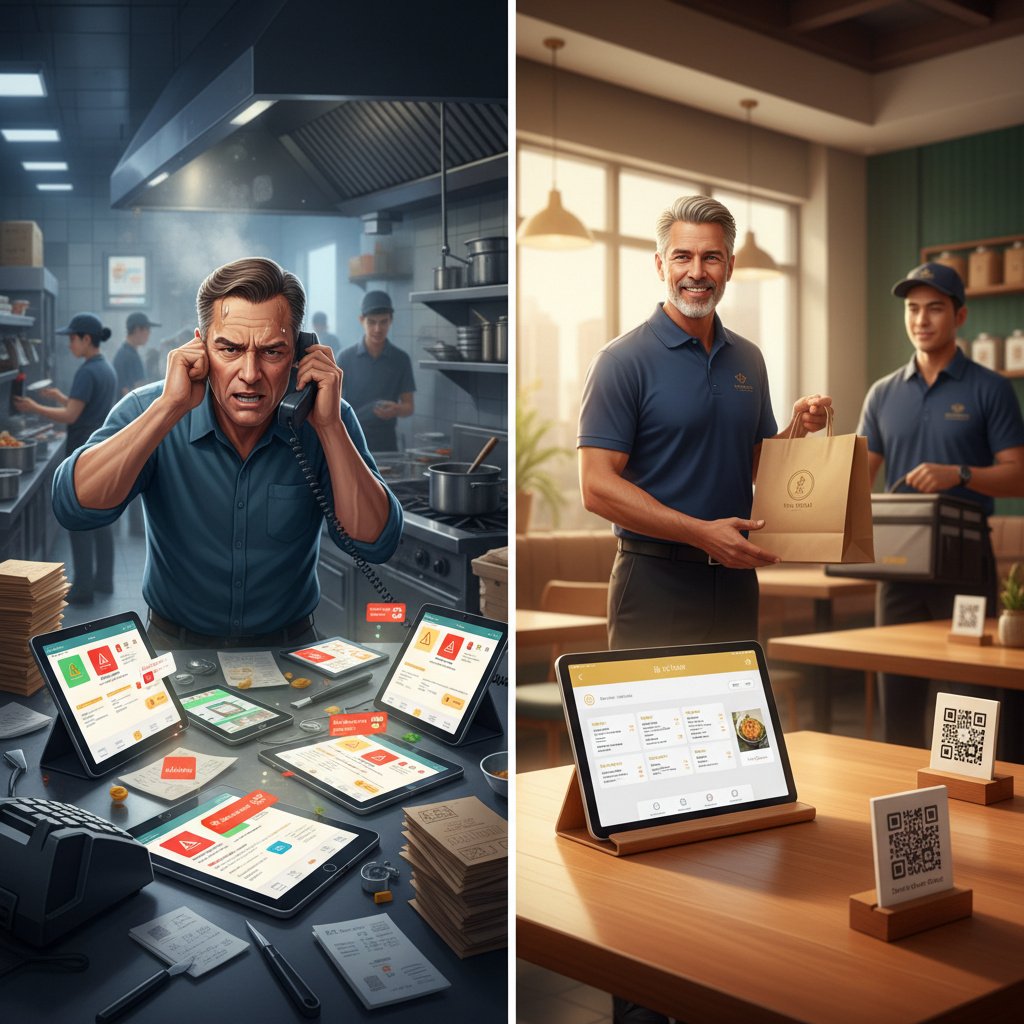
Ever feel like your restaurant kitchen is being run by third-party tech executives who have never held a chef’s knife? You started your business to be the commander of your own ship, yet every Friday night is a barrage of chaotic tablet pings, high commission fees, and frantic phone calls trying to explain the difference between red curry and spicy basil. It is enough to make any mission-driven leader want to pull the plug entirely.
For veteran business owners running Thai establishments, the battle lines are drawn right at the front counter. The classic phone-order model is a tactical drain, requiring your staff to manually transcribe complex orders while the kitchen falls behind. Why let third-party apps take a massive cut of your hard-earned margins when you can establish a direct line of communication with your customers? The key to taking back control of your operations is a robust, custom-branded restaurant e-commerce platform.
The True Cost of Third-Party Dependency
Think about a typical night managing off-premise dining. If you are relying solely on delivery aggregators, you are likely giving up 15 to 30 percent of every ticket. That is not just a fee; it is your profit margin walking out the door in a branded third-party bag. Even worse, you do not own the customer data. When a patron orders your signature Pad Thai through an aggregator, that platform—not you—owns their email, their order history, and their loyalty.
Consider the strategic shift executed by Thai Dish, a family-run restaurant that decided to stop reacting to technological headaches and start running orders on their own terms. By rolling out a dedicated ordering website, a branded mobile app, and placing strategic QR codes on their tables and packaging, they bypassed the middleman. The result? They secured direct access to their customer data and increased their monthly net revenue by approximately $45,000. That is the power of direct-to-consumer food ordering systems.
Transitioning to a direct model does not mean cutting out delivery entirely. It means using modern restaurant technology to centralize everything into a single, unified interface. The leading restaurant e-commerce solutions allow you to connect directly to major delivery networks for driver dispatch while keeping the transaction, the customer relationship, and the lion’s share of the profit on your books.
Cracking the Complexity of Thai Customization
Anyone who has run a Thai kitchen knows that the menu is a different beast compared to standard Western fare. A single order of Pad See Ew requires multiple micro-decisions: protein choice (chicken, beef, crispy pork belly, or tofu), spice level on a scale from one to five, noodle thickness, and specific prep styles like sauce on the side. When your staff takes these orders over a noisy phone line, errors are guaranteed.
This is where specialized food ordering systems built for Asian cuisine shine. High-quality systems like those from Blogic Systems and Brilliant POS integrate directly with your kitchen display system (KDS) and feature intelligent language translation capabilities. Your front-of-house customer can enter the order in English on your sleek mobile app, pointing exactly to their preferred meat type and spice level. The system instantly translates those customization parameters into Thai or another preferred language for your kitchen staff on the KDS monitor. It eliminates translation errors, cuts down on ticket waste, and speeds up table turnover.
Best of all, these systems utilize picture-based menu identification. This ensures that regardless of language barriers, your kitchen staff and runners know exactly what a dish should look like before it leaves the pass. You get flawless execution without needing your expediter to act as a full-time translator.
Taking Command of Delivery and Payments
If you are still routing delivery drivers with paper slips, highlighter pens, and manual Google Maps searches, you are losing valuable time. Modern online ordering systems for Thai restaurants feature integrated delivery management functionality. The system automatically groups deliveries geographically, generates real-time driving directions for your dispatch team, and tracks drivers in the field. This keeps your delivery process entirely transparent, protecting your reputation from the dreaded “where is my food?” call.
On the accounting side, reconciling cash, credit, and delivery payments can be a nightmare that eats up your Sunday mornings. The solution lies in robust, end-to-end POS accounting integration. Top-tier platforms sync directly with platforms like QuickBooks, updating your daily sales ledger, inventory costs, and tax liabilities automatically. Whether a customer pays via Apple Pay, Google Pay, a EMV chip card, or even EBT, your books stay crisp and audit-ready.
To see how your operation stacks up, consider this quick comparison of operational models:
| Operational Metric | Legacy / Third-Party Dominant | Branded Direct Ordering Systems |
|---|---|---|
| Average Commission Fees | 15% to 30% per order | Flat monthly fee or low transaction fee (under 3%) |
| Customer Data Ownership | Owned by the third-party platform | 100% owned by your restaurant |
| Menu Customization (e.g., Thai spices) | Rigid, error-prone text templates | Dynamic step-by-step modifier mapping |
| Kitchen Communication | Manual entry from external tablets | Direct KDS routing with auto-translation |
A Battle-Tested Blueprint for Implementation
Are you ready to establish your own direct-ordering beachhead? The transition does not have to happen overnight. Begin by auditing your current tech stack. Look for a restaurant technology provider that supports multi-channel order routing—meaning they can handle phone, table, mobile, and web orders through a single node of truth.
Next, deploy QR codes strategically. Put them on your physical menus for contactless in-venue ordering, and stick them on your takeout containers with a clear call to action: “Scan here to order direct next time and get 10% off.” This simple incentive moves third-party diners into your ecosystem, converting one-time high-fee transactions into lifetime, high-margin relationships.
Finally, leverage the data. Use the built-in analytics engines of your POS to run target reports. See which seasonal specials are driving repeat visits, and use the integrated marketing tools to send automated promotions to customers who haven’t ordered in thirty days. This is not just a technology upgrade; it is a strategic maneuver to regain control of your margins, your staff’s time, and your business’s future.
You served your country with precision and discipline. It is time to bring those same standards to your digital storefront. By investing in a branded, direct-ordering system, you protect your hard-won revenue and build a sustainable brand that customers love to support. Take command of your digital presence today, and let your kitchen do what it does best: serve incredible, authentic food on your own terms.











[…] businesses: Grants, tax breaks, and low-interest loans tailored for veteran businesses. […]
[…] platforms like Instagram and Facebook to create […]
[…] Examples of Workflow […]
[…] Automation tools collect and analyze data, giving you insights to make smarter choices. Google Analytics, for instance, tracks website…
[…] like LinkedIn and Instagram are powerful networking tools. Share valuable content, engage with industry leaders, and showcase […]