
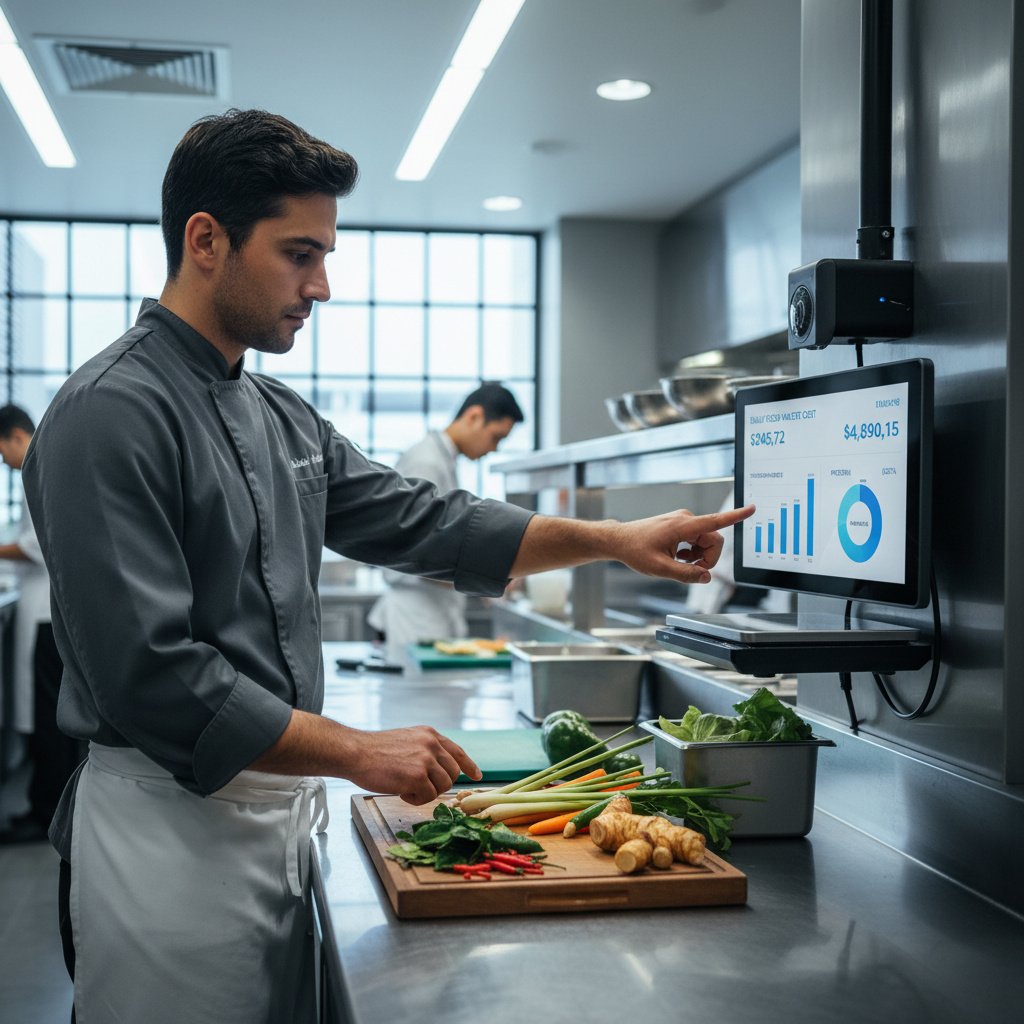
The Hidden Margin Killer in Commercial Kitchens
Every seasoned operator knows that victory on the balance sheet is won in the trenches of day-to-day operations. Yet in thousands of commercial kitchens across the country, line-item profitability bleeds out quietly through the back door. Food waste is rarely a grand failure of strategy; it is a compound failure of visibility and daily discipline. From spoiled bulk prep to oversized plates and inaccurate inventory rotation, unmeasured shrink strips double-digit percentages from bottom-line profits.
For veteran business owners, treating restaurant waste reduction as merely a soft environmental initiative misses the target entirely. Waste control is a high-yield cost control system. When you automate food waste tracking, you install real-time operational intelligence into your line operations. You replace gut feeling with hard telemetry, transforming an invisible expense into a source of immediate working capital.
Where Food Margins Go Missing
In a standard food service operation, kitchen shrink clusters into four primary operational breakdowns:
- Spoilage: High-value perishables rotting in walk-ins due to poor First-In, First-Out (FIFO) discipline or inaccurate order forecasting.
- Overproduction: Kitchen prep teams batch-cooking based on historic habit rather than actual real-time traffic demand.
- Prep Errors: Excessive trimming, incorrect yields, or recipe execution mistakes at the prep station.
- Plate Waste: Misaligned portion sizes or menu items that customers consistently leave behind.
Consider a high-volume Thai restaurant handling complex, highly perishable ingredients. Fresh holy basil, kaffir lime leaves, lemongrass, and specialized curry pastes require precise inventory timing. If a prep cook trims excessive leaf stock or over-preps sensitive coconut milk bases ahead of a slow Tuesday shift, that margin vanishes forever. Without automated tracking, the financial impact stays buried deep inside the overall monthly food cost percentage.
The Automation Tech Stack: From Invisible Loss to Live Data
Manual waste logs fail because they rely on human compliance during high-stress operational rushes. Line cooks under pressure simply do not stop to write down half a pan of cold rice noodles on a paper clipboard. Modern automation changes the economic equation by making data collection continuous, seamless, and frictionless.
A modern waste reduction automation stack integrates four clean layers:
1. Quick-Touch Waste Logging
Staff log discard items on ruggedized touch-screen tablets positioned directly above trash or compost stations. Using intuitive interfaces, an employee can record the item, volume, and reason—such as burned, spoiled, or over-prepped—in under ten seconds. Speed is critical; if logging takes more than fifteen seconds, compliance drops off a cliff.
2. Smart Measurement and Computer Vision
Connected Internet of Things (IoT) scales paired with optical camera sensors sit at key discard points. As food enters the bin, smart vision systems automatically recognize the ingredient or dish, log its weight, calculate its recipe cost, and stamp the time and shift responsible. The system learns your menu items within three to seven days of initial calibration.
3. POS and Inventory System Integration
Isolated data is useless data. The waste automation system links directly with your Point of Sale (POS) and inventory software. By cross-referencing food thrown away against actual sales volume, the system reveals true cost-per-dish metrics and pinpoints operational bottlenecks down to specific prep stations or shift crews.
4. Predictive Analytics and Automated Reordering
Advanced algorithms process historic sales trends, weather forecasts, local events, and actual ingredient depletion speeds. The platform generates precise daily prep guides and sends proactive alerts to order managers when stock levels diverge from actual demand, stopping over-purchasing before the truck leaves the vendor depot.
Executing a Staged Implementation: Crawl, Walk, Run
High-performing operators do not launch sweeping operational changes overnight without proving the concept first. A staged implementation lowers operational risk, drives immediate buy-in from kitchen staff, and demonstrates clear return on investment early.
Phase 1: Baseline Establishment (Weeks 1–2)
Install hardware at primary disposal points without introducing complex rules or punishment. The goal of the initial two-week baseline period is purely objective intelligence gathering. You cannot fix what you do not measure. This audit uncovers your primary loss categories, whether it is over-trimmed proteins or over-batched starch bases.
Phase 2: Target High-Impact Hotspots (Weeks 3–6)
Focus immediately on your top three highest-value waste categories. If data reveals that prepped sauces or expensive proteins make up 60% of overall dollar loss, adjust prep sheets immediately. Train kitchen leaders on specific portion tools and fine-tune batch sizes for off-peak service windows.
Phase 3: Automated Purchasing and Menu Optimization (Week 7 Onward)
With clean baseline data integrated into your inventory platform, activate automated purchase recommendations based on supplier lead times and actual ingredient shelf-life. Evaluate menu engineering: if an ingredient is consistently wasted due to low cross-utilization across dishes, re-engineer the menu or remove the underperforming item entirely.
Empowering Kitchen Leadership and Operational Culture
Technology does not replace effective management; it amplifies good leadership. Automated tools depend on clear accountability, clean data hygiene, and consistent execution across shifts. Frame food waste reduction not as a heavy surveillance program, but as a professional standard of operational excellence.
Assign dedicated “Waste Champions” within your kitchen team—often junior prep supervisors or shift leads—to monitor system compliance and review weekly shift performance. Share clear performance indicators with the team, such as daily kilograms of food waste avoided or targeted food cost percentages. When kitchen staff see that eliminating shrink directly protects operating margins and secures business growth, culture shifts from compliance to genuine ownership.
The ROI: Tighter Margins and Measurable Environmental Leadership
The financial case for restaurant waste reduction automation is simple and immediate. Industry benchmarks consistently show that systematic waste tracking and automated menu optimization can reduce raw food costs by 2 to 4 percentage points. For a restaurant generating $2 million in annual revenue, shifting food cost down by 3% returns $60,000 directly to net operating income year after year.
Simultaneously, environmental responsibility becomes a direct, verified outcome of superior operational discipline. Lowering kitchen waste cuts disposal fees, minimizes landfill impact, and strengthens brand reputation among eco-conscious diners who value authentic sustainability. Rather than buying empty marketing claims, customers support businesses that run clean, efficient, and responsible operations.
Eliminating waste in commercial kitchens is not a complex philosophical issue—it is an execution challenge. By deploying automated waste tracking, integrating POS data, and applying disciplined operational routines, veteran business owners can shut down costly shrink, lock in higher profit margins, and set the standard for environmental responsibility in modern food service.
Book a 15 minute discovery call to find out more today at https://digifidelis.com/calendar/











[…] businesses: Grants, tax breaks, and low-interest loans tailored for veteran businesses. […]
[…] platforms like Instagram and Facebook to create […]
[…] Examples of Workflow […]
[…] Automation tools collect and analyze data, giving you insights to make smarter choices. Google Analytics, for instance, tracks website…
[…] like LinkedIn and Instagram are powerful networking tools. Share valuable content, engage with industry leaders, and showcase […]