
In military operations, supply chain visibility makes the difference between mission success and costly failure. Every gallon of fuel, round of ammunition, and ration crate is tracked because unaccounted loss erodes combat power. Yet when veteran entrepreneurs transition into hospitality, they often encounter an industry where inventory quietly bleeds away in the dark.
In the typical dining establishment, food costs swallow between 28% and 35% of total sales. For a kitchen generating $800,000 in revenue, that means anywhere from $224,000 to $280,000 moves across the receiving dock every year. A staggering portion of that inventory never makes it to a paying customer. It gets trimmed away in prep, overcooked on the line, spoiled in walk-in coolers, or tossed into the trash during late-night cleanups.
For decades, traditional management treated kitchen waste as an unavoidable cost of doing business. Today, automated measurement systems have changed the math entirely. By applying real-time data capture to everyday kitchen workflows, restaurant waste reduction has shifted from a vague environmental aspiration into one of the most reliable cost reduction tools available to modern operators.
The Hidden Drag on Restaurant Margins
The hospitality sector operates on notoriously narrow margins, often hovering between 4% and 7%. When margins are that tight, increasing sales volume is not always the fastest way to build profit. Generating an extra $50,000 in top-line revenue requires more labor, higher utility usage, additional marketing spend, and increased wear on equipment. Conversely, saving $10,000 in wasted food drops directly to the bottom line.
Food loss inside commercial kitchens generally splits into five distinct streams:
- Prep Trim: Usable product discarded during butchering, peeling, and chopping.
- Overproduction: Batches of soups, sauces, and bases prepared beyond daily demand.
- Spoilage: Perishables forgotten in storage or mismanaged through poor stock rotation.
- Plate Waste: Portions served too large for guests to finish.
- Ordering Errors: Miscalculations that flood storage with raw goods before prior inventory clears.
The fundamental challenge is not that kitchen staff do not care. It is that manual tracking systems fail under pressure. Clipboards and pencil logs rely on human compliance during the busiest rushes—the exact moments when errors spike. When kitchen crews are slamming tickets on a Friday night, nobody stops to weigh discarded trim or log burned proteins. Automated tracking systems solve this by capturing data seamlessly without slowing down the line.
How Kitchen Automation Captures Real-Time Loss
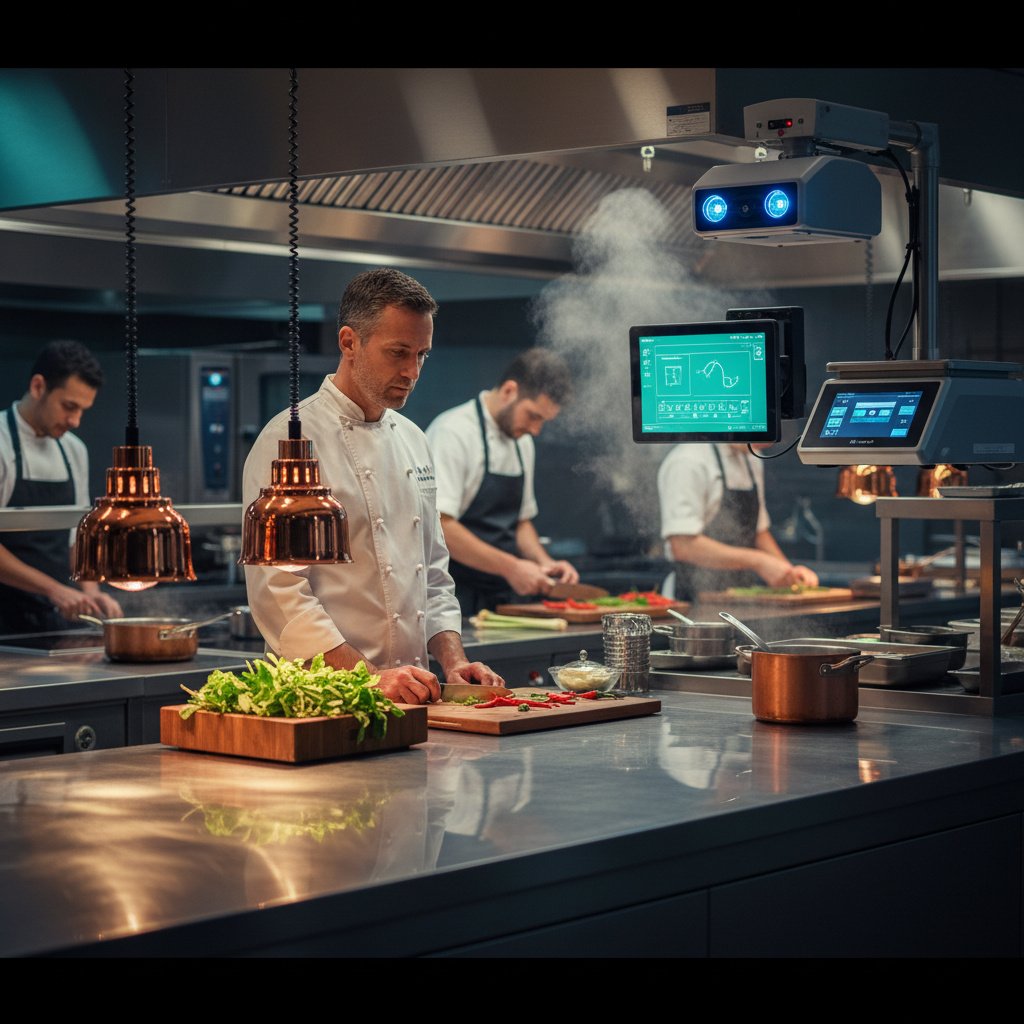
Modern waste tracking combines smart scales, computer vision, and machine learning to make waste visible in seconds. Instead of a standard trash bin, kitchens position an integrated station beneath an optical camera and digital scale. When a cook scraps expired prep or plate scrapings, the sensor detects the action instantly.
The artificial intelligence identifies the ingredient—whether it is raw chicken, chopped scallions, or cooked jasmine rice—records the weight, and logs the timestamp into a cloud dashboard. The entire process takes less than three seconds and requires zero manual data entry from staff.
By digitizing this stream, operators move from rough estimates to objective facts. Kitchen managers can view daily, weekly, and shift-level reports that pinpoint exactly where money is leaking. They can see whether overproduction peaks on Tuesday afternoons or if a specific prep shift consistently trims 15% more produce than standard operating procedures allow.
The Return on Investment: Why the Numbers Work
Financial discipline is the primary driver behind smart kitchen technology. Industry data demonstrates that every $1 invested in food-waste reduction initiatives returns roughly $7 to $8 in operational savings. In high-volume environments, documented returns have reached as high as 14 to 1.
Automated measurement typically lowers total food costs by 2% to 6%. For an independent operator managing a $250,000 annual food budget, a conservative 3% reduction recaptures $7,500 annually. For multi-unit operations or high-volume kitchens with food spends exceeding $1 million, that same percentage represents $30,000 to $60,000 in recovered capital every year.
Furthermore, the technology footprint requires a surprisingly low capital outlay. Over a three-year implementation, full hardware and software deployments average roughly 0.4% of annual food purchases. Because the payback period typically resolves within three to six months, smart tracking acts as a self-funding operational upgrade rather than an open-ended software expense.
Case in Point: Precision and Perishability in a Thai Restaurant
To see how automation works under demanding conditions, consider the operational reality of an authentic Thai restaurant. Thai cuisine relies heavily on intense flavor profiles built from highly perishable, delicate ingredients: fresh Thai holy basil, lemongrass, kaffir lime leaves, cilantro roots, galangal, fresh chili peppers, and rich coconut milk bases.
These ingredients carry brief shelf lives and high sensitivity to temperature and handling. When prep cooks misread demand for a signature green curry base or prep excessive quantities of fresh herbs, the unused product turns brown and loses aroma within 48 hours. Traditionally, spoiled batches quietly disappear into the dumpster without the owner knowing whether the loss stemmed from inaccurate order forecasts or improper batch sizing.
When automated waste sensors are introduced to this environment, the blind spots vanish:
- Herb and Produce Optimization: The system flags that 20% of fresh Thai basil leaves are discarded during Wednesday morning prep, prompting leadership to adjust supplier delivery cadences and retrain line cooks on proper damp-towel refrigeration storage.
- Curry Base Yield Management: Data reveals that three gallons of coconut milk curry base spoil every Sunday evening. The kitchen adjusts its weekend batch pars from five gallons down to three, supplementing with smaller on-demand runs during peak hours.
- Noodle and Rice Portions: Plate waste tracking identifies that 18% of jasmine rice sides return uneaten on specific lunch combo specials, enabling management to right-size standard portions without diminishing guest satisfaction.
By pairing technology with culinary discipline, the operator protects authentic flavor profiles and dish consistency while eliminating thousands of dollars in spoiled prep.
Connecting Environmental Responsibility with Cost Control
While the immediate argument for automation rests on margin defense, environmental responsibility provides an equally compelling advantage. Discarded food represents wasted water, agricultural energy, packaging, and transportation emissions. When organic waste decomposes in municipal landfills, it generates methane—a greenhouse gas significantly more potent than carbon dioxide.
Today’s consumers, particularly younger demographics, actively seek out brands that practice genuine sustainability. However, public relations messaging means little without verifiable operational truth. Automated tracking provides authenticated data on diverted waste, reduced carbon impact, and improved resource efficiency.
Veteran business owners understand that sustainable practices should never rely on subsidies or sacrificial budgeting. The most durable sustainability models are those where waste elimination directly strengthens the balance sheet. Preventing waste at the loading dock and prep table is both an environmental victory and a financial imperative.
The Five-Step Implementation Framework: The 5-A Model
Technology alone does not fix broken habits. Software provides intelligence, but leadership enforces execution. Veteran operators succeed by deploying automated systems within a structured five-step management loop:
1. Audit: Establish a baseline. Run automated tracking for two to three weeks without altering kitchen routines to capture an unvarnished view of daily loss patterns.
2. Automate: Integrate smart scales and optical sensors directly into existing prep lines and dish-clearing stations so data capture requires zero friction.
3. Analyze: Review weekly dashboard trends with shift leaders. Focus on the top three cost drivers rather than attempting to fix every minor ingredient at once.
4. Adjust: Update prep pars, retrain staff on portion control, revise raw order quantities with purveyors, and recalibrate batch sizes to match real-time sales trends.
5. Account: Establish clear team accountability. Celebrate prep squads that hit target yield percentages, turning waste reduction into a shared operational metric.
Mission-Ready Margins
In a volatile economic climate marked by fluctuating wholesale prices and rising labor rates, restaurant operators cannot afford unmonitored loss. Hope is not a management strategy, and manual clipboards cannot keep pace with modern kitchen volume.
Automated waste reduction gives owners absolute command over their inventory. It replaces guesswork with objective data, builds operational resilience, and aligns environmental stewardship with aggressive cost control. For veteran business owners dedicated to building enduring, profitable enterprises, deploying waste automation is not merely an equipment upgrade—it is a strategic standard that protects the bottom line on every single shift.
Book a 15 minute discovery call to find out more today at https://digifidelis.com/calendar/











[…] businesses: Grants, tax breaks, and low-interest loans tailored for veteran businesses. […]
[…] platforms like Instagram and Facebook to create […]
[…] Examples of Workflow […]
[…] Automation tools collect and analyze data, giving you insights to make smarter choices. Google Analytics, for instance, tracks website…
[…] like LinkedIn and Instagram are powerful networking tools. Share valuable content, engage with industry leaders, and showcase […]