
The Hidden Margin Bleeding Out the Back Door
Every seasoned operator understands an unvarnished kitchen truth: profit margins are won or lost in fractions of an ounce. When food inventory arrives at the loading dock, it represents hard capital. When that same inventory exits through the dumpster behind the kitchen, it is unrecoverable equity. For veteran business owners, disciplined inventory accountability is second nature. Yet in modern restaurant operations, traditional waste control often relies on clipboard logs, end-of-month food cost reconciliations, and subjective post-mortems. By the time a food cost spike shows up on an income statement, the capital is already long gone.
In high-volume commercial kitchens, food waste is rarely caused by malice. It stems from blind spots. Overproduction during morning prep, inaccurate par levels driven by gut instinct rather than demand data, inconsistent trimming on the prep line, and undetected plate waste all siphon margin quietly. Restaurant waste reduction automation systematically eliminates these blind spots. By pairing optical AI sensors, smart scales, and connected software platforms, automation converts kitchen scrap into actionable operational intelligence. It shifts waste management from a reactive, punitive chore into a predictive system of operational discipline.
The Operational Mechanics of Automated Waste Tracking
Veteran operators are rightly skeptical of technology that introduces administrative drag to line-level staff. If a tool slows down a cook during dinner service, it will inevitably be abandoned. Modern waste reduction automation succeeds because it functions on a frictionless three-tier architecture: capture, analysis, and execution.
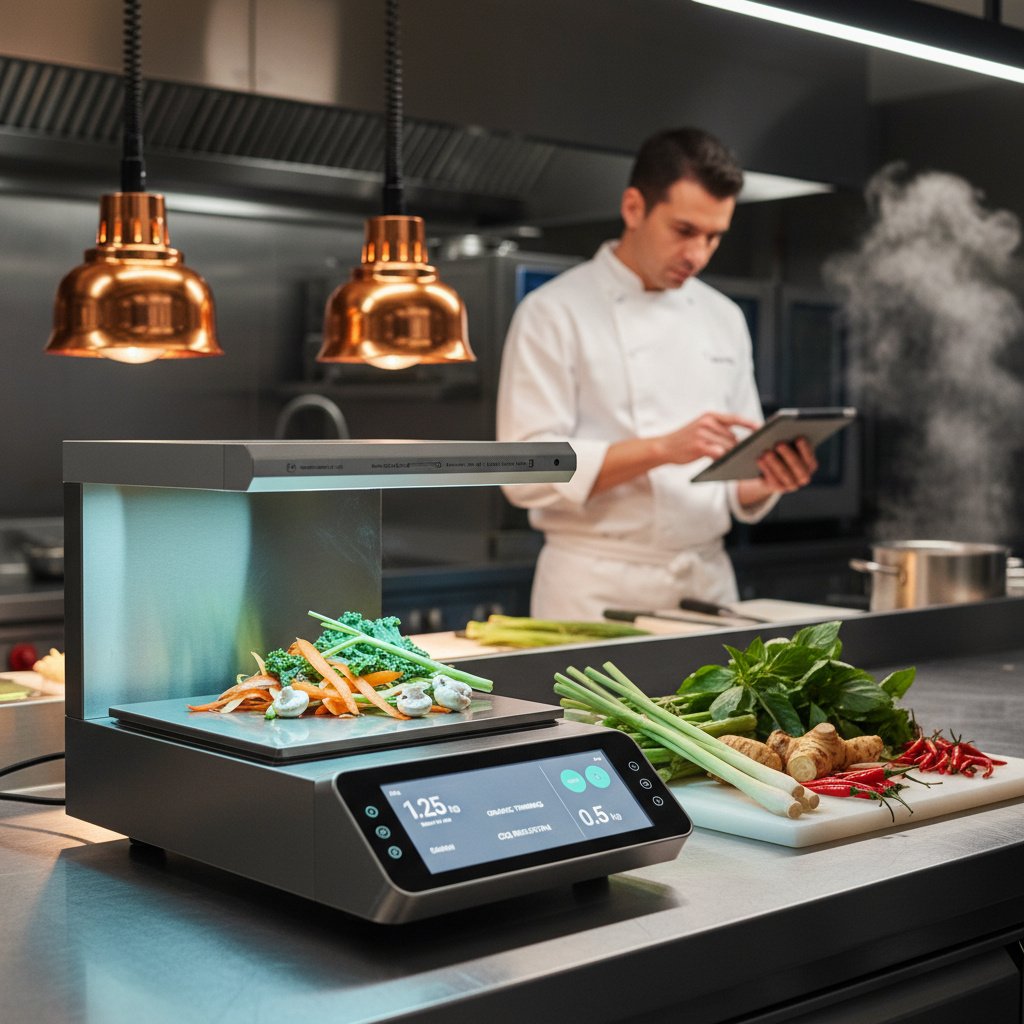
The capture tier relies on either above-bin optical units or in-bin digital smart scales. As a line cook or prep chef discards trim, spoiled produce, or overcooked batches, high-resolution cameras use computer vision to classify the ingredient—identifying whether it is chicken breast, discarded jasmine rice, or fresh Thai basil. Simultaneously, integrated scales record the exact weight in seconds without requiring manual input. The process takes virtually zero extra effort from the kitchen team.
The analysis tier immediately processes that raw capture data through localized algorithms linked to your point-of-sale (POS) and inventory control databases. Rather than simply logging that twenty pounds of organic waste entered the bin, the system calculates the precise unit cost, maps it against the current prep shift, and flags whether the waste was caused by over-trimming, expiration, line drop, or post-consumer plate waste.
The execution tier transforms these diagnostics into management directives. Shift supervisors receive clear, data-backed adjustments: reduce tomorrow’s curry paste batch by 15%, retrain morning prep on poultry yield standards, or adjust dinner portioning on slow-moving sides. Automation does not replace kitchen leadership; it provides commanders with the exact battlefield coordinates needed to protect their margins.
High-Variance Environments: The Thai Culinary Case Study
To understand the high-stakes impact of automated waste tracking, examine the operational realities of a high-end Thai restaurant. Thai cuisine is renowned for its vibrancy, balance, and complex layering of flavors. Operationally, it is also one of the most perishable, prep-intensive menus in the food service sector.
Consider the core bill of materials: galangal, kaffir lime leaves, lemongrass, fresh bird’s eye chilies, holy basil, coconut milk emulsions, specialty sauces, and precisely cut proteins. These ingredients carry rapid spoilage curves and require intricate prep workflows. When a station prep cook trims fresh lemongrass or cleans aromatic herbs, inconsistent technique across shifts can lead to a 12% to 18% variance in usable yield. Over an operating quarter, that variance alone can wipe out thousands of dollars in bottom-line profit.
Furthermore, batch cooking in Thai kitchens presents frequent overproduction traps. Simmering large pots of green curry base or massaman sauce ahead of a Friday rush seems like sound operational readiness. However, if unseasonable weather or localized shift patterns depress covers, unconsumed sauces with dairy or coconut bases quickly reach holding-time limits and face disposal. Automated waste systems identify recurring batch surpluses down to the hour. Kitchen managers can replace static par sheets with dynamic, predictive prep targets tailored to dayparts, weather trends, and historical customer velocity.
Data-Driven Cost Reduction: The Core Performance Metrics
Experienced operators do not manage by sentiment; they manage by verifiable key performance indicators (KPIs). Implementing automated waste systems allows leadership to benchmark baseline loss and establish quantifiable reduction targets across several primary operational metrics:
- Food Cost Percentage Variance: Closing the gap between theoretical food cost (what dishes should cost based on recipe yields) and actual food cost (what was spent on purchases), often recovering 200 to 600 basis points in margin.
- Pre-Consumer Spoilage Rate: Measuring raw ingredients thrown away prior to cooking, directly informing vendor procurement par levels and delivery frequencies.
- Station-Specific Waste Ratios: Pinpointing whether loss originates at the raw prep station, the sauté line, or the dish pit, allowing targeted coaching rather than broad team blame.
- Plate Waste by Menu Item: Tracking post-consumer returns to discover if signature dishes feature excessive portioning that diners systematically leave uneaten.
A mid-sized restaurant operating at $1.8 million in annual revenue with an industry-standard 32% food cost spends $576,000 yearly on ingredients. Reducing food waste by even 4% via precision forecasting and portion accountability returns more than $23,000 directly to net operating income. For independent and veteran-owned operators, that capital can fund staff retention programs, facility upgrades, or strategic expansion.
Environmental Responsibility as a Commercial Asset
While margin protection justifies the initial balance-sheet investment, the environmental dividend provides compounding brand value. Methane emissions from organic matter decomposing in municipal landfills represent one of the primary drivers of commercial greenhouse gas footprints. When food is discarded, every unit of water, transportation fuel, and agricultural labor required to produce it is discarded alongside it.
For modern veteran operators, sustainability is not an abstract slogan; it is disciplined stewardship of critical resources. Waste reduction automation produces verified, auditable data trails. Instead of issuing vague green marketing claims, operators can publish certified impact metrics: total pounds of organic waste diverted from landfills, measurable carbon offset equivalents, and verified reduction benchmarks. In urban markets where diners actively select dining destinations based on environmental accountability, this institutional transparency builds durable customer trust and community standing.
Strategic Implementation and Governance
Deploying automated waste management requires structured operational integration. Veteran owners should approach rollout as a phased management campaign:
- Audit System Compatibility: Ensure the automation platform integrates cleanly with your existing POS and enterprise inventory architecture. Siloed platforms generate redundant data entry and administrative friction.
- Start at High-Waste Pressure Points: Begin sensor capture at the highest-volume prep stations and dish pits where prep trim and plate discard are heaviest. Master the feedback loop there before expanding to secondary stations.
- Establish a Blame-Free Operational Culture: If staff believe automated scales are punitive surveillance tools designed to penalize honest mistakes, they will find workarounds. Position the platform as an engineering tool designed to standardize training, optimize prep workloads, and eliminate guesswork.
- Incorporate Data into Daily Briefings: Review top waste categories during morning shift lineups. Give line cooks ownership over yield metrics and celebrate week-over-week waste reductions as operational milestones.
Automation does not compensate for weak management, slack receiving standards, or uncalibrated recipe books. It does, however, serve as an uncompromising operational mirror. For veteran business owners dedicated to running disciplined, profitable, and environmentally responsible kitchens, waste reduction automation transforms invisible losses into decisive competitive advantage.











[…] businesses: Grants, tax breaks, and low-interest loans tailored for veteran businesses. […]
[…] platforms like Instagram and Facebook to create […]
[…] Examples of Workflow […]
[…] Automation tools collect and analyze data, giving you insights to make smarter choices. Google Analytics, for instance, tracks website…
[…] like LinkedIn and Instagram are powerful networking tools. Share valuable content, engage with industry leaders, and showcase […]